


Planning a trip to Germany and need to follow a gluten-free diet? Don’t worry – with a few tips and our support, you can enjoy your stay without stress! Our Coeliac Association offers a date base showing restaurants, hotels, bakeries and more that provide gluten-free options.
Hello and welcome to Germany!
We are glad you found your way to our coeliac association. Before we start with the hard facts we have good news for people with coeliac disease who will visit our country – you can survive in Germany for sure.
For our members there is a free map available, pointing out restaurants, hotels, bakeries, butchers, supermarkets, health food shops etc. that offer gluten free options. If you send us an email with the destination or cities you will visit, we can provide you the search result of our map.
Have a good time in Germany and do not hesitate to contact us if you have any further questions:
Phone: +49 711 – 45 99 81-0, E-Mail: Contact us
Buying gluten free products
Finding gluten-free products is easy, as they are readily available in various places, including:
- supermarkets (e.g. Aldi, Edeka, Lidl, Kaufland, Norma, Netto, Rewe)
- drugstores (e.g. dm, Müller, Rossmann)
- health food shops („Reformhaus“, Bioland)
However, each shop provides a different variety of products depending on the size and the location of the shop.
Gluten free licensed products are labelled with the crossed grain symbol. If you can not find any gluten free licensed products, simply check the ingredients or reach out to us for assistance or further information.
If you stay longer and with a German family, ask them to look at our list of products to see which they can use to prepare gluten free meals for you. They can order the list at our office.
Eating out gluten free
When staying at a hotel it is also worth trying, before booking your rooms, to ask hotel staff to order some gluten free products for you.
When dining at restaurants, don’t hesitate to talk to the chef and explain your dietary needs to help decide which meals are save for you. Below we’ve included a brief text in German that you can use to help you explain your request to the staff.
Please give this to the kitchen - Bitte an die Küche
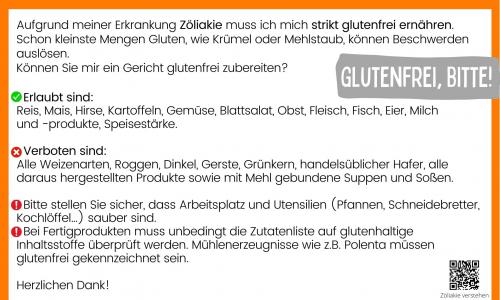
Please give this to the kitchen
I have an autoimmune condition called coeliac disease which means I must follow a strict gluten free diet.Even trace amounts of gluten, for example from crumbs, flour or contaminated kitchen utensils, can be harmful.
Therefore, I ask that you prepare a completely gluten free dish, avoiding any cross-contamination.
✅ Suitable foods:
Rice, corn, millet, buckwheat, amaranth, quinoa, potatoes, legumes, vegetables, leaf salads, fruit, meat, fish, eggs, milk and dairy products, starch flours made from potatoes, rice or corn.
❌ Unsuitable foods:
Wheat (starch), rye, barley, spelt, green spelt, commercially available oats, as well as all products containing them such as bread, breadcrumbs, sauces and soups containing flour.
Please take care to:
• Only use clean utensils, pans, pots and chopping boards that are not contaminated with gluten.
• When possible, use a separate work area.
• Only use pre-processed foods that are free from gluten containing ingredients (e.g. wheat, rye, barely).
• Only use polenta, flour, grain flakes (such as oats) and semolina when they are explicitly marked as gluten free. Check if lentils contain any other grains.
• Soy sauce, imported vinegars und salad cream often contain gluten.
Thank you very much for your care and understanding – it gives me the opportunity to enjoy a safe meal out. I am happy to help if there is anything you are unsure about.
Bitte an die Küche
Ich bin von der Autoimmunerkrankung Zöliakie betroffen, und muss deshalb konsequent glutenfrei essen.
Bereits Spuren von Gluten, etwa durch Krümel, Mehlstaub oder verunreinigtes Küchenzubehör, können Beschwerden auslösen.
Ich bitte Sie daher, mein Gericht vollständig glutenfrei und ohne jegliche Verunreinigung zuzubereiten.
✅ Geeignete Lebensmittel:
Reis, Mais, Hirse, Buchweizen, Amaranth, Quinoa, Kartoffeln, Hülsenfrüchte, Gemüse, Blattsalat, Obst, Fleisch, Fisch, Eier, Milch und Milchprodukte, Speisestärke aus Kartoffeln, Reis oder Mais.
❌ Nicht geeignet Lebensmittel:
Weizen(-stärke), Roggen, Gerste, Dinkel, Grünkern, handelsüblicher Hafer sowie alle daraus hergestellten Produkte wie Brot, Panaden, Soßen oder Suppen mit Mehl.
Bitte beachten Sie:
• Nur saubere, nicht mit Gluten verunreinigte Arbeitsgeräte, Pfannen, Töpfe und Schneidebretter verwenden.
• Wenn möglich, einen separaten Arbeitsplatz nutzen.
• Nur Fertigprodukte verwenden, die keine glutenhaltigen Zutaten (z. B. Weizen, Roggen, Gerste) enthalten.
• Polenta, Mehl, Flocken und Grieß nur verwenden, wenn sie ausdrücklich als glutenfrei gekennzeichnet sind. Linsen auf Fremdgetreide überprüfen.
• Sojasauce, Reisessig und Salatmayonnaise enthalten häufig Gluten.
Vielen Dank für Ihre Sorgfalt und Ihr Verständnis – Sie ermöglichen mir damit eine sichere Mahlzeit. Bei Unsicherheiten helfe ich gerne weiter.